
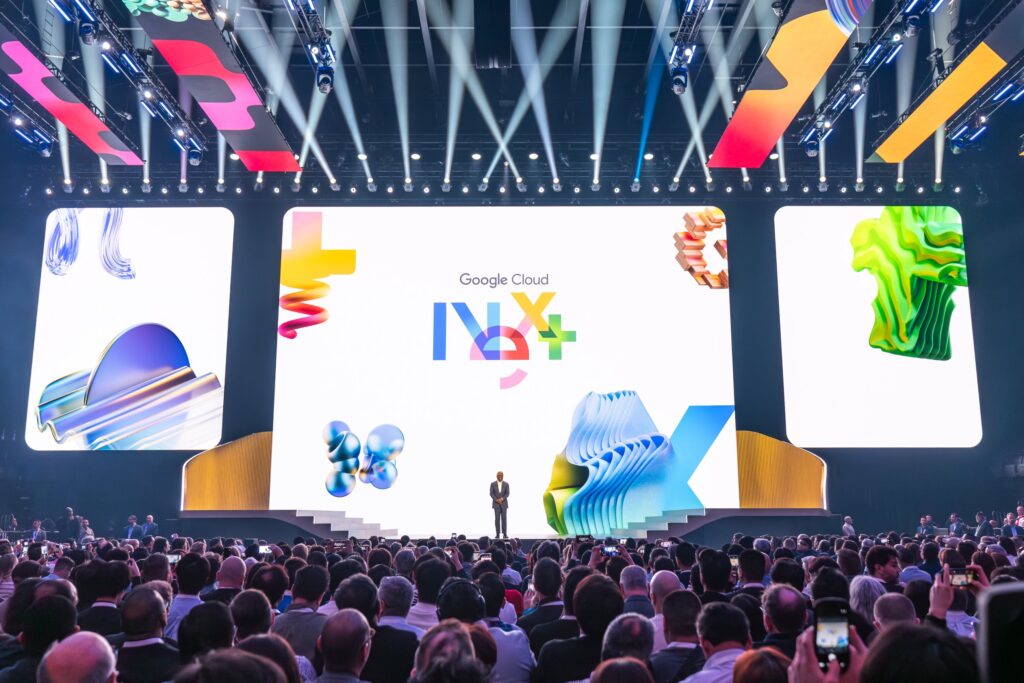
🚀 Wrapping up an incredible week at Google Cloud NEXT ’26 in Las Vegas! ☁️
Still buzzing from three electric days on the ground. For our Intelagen team, hyper-focused on providing elite GPUaaS, the biggest takeaway was clear: the AI revolution has entered the Agentic era, and it is fundamentally bound by the bare metal it runs on.
As Google Cloud CEO Thomas Kurian perfectly summarized in his recent interview, the evolution of AI has moved from chat, to content generation, and now to agents. As he put it, “The ultimate abstraction is abstracting the rest of the world as a computer.” This radical shift—where models must hold context for hours and seamlessly execute complex multi-step tasks—is exactly what drove the total redesign of the underlying AI Hypercomputer.
Google’s Amin Vahdat delivered a brilliant breakdown of the physical realities of this shift. Solving intelligence today isn’t just a silicon design challenge—it’s a massive systems engineering problem spanning enclosures, liquid cooling, custom networking, and the bare-metal servers themselves.
Here is our breakdown of the massive infrastructure leaps redefining high-density AI compute:
🔥 The 8th Gen TPU Split & Boardfly Google has decisively split its custom silicon strategy to address the differing physics of pre-training versus real-time agentic serving:
TPU 8t (Training): Built for mega-scale frontier models, delivering 121 exaflops of native compute and 2 petabytes of shared memory within a massive 9,600-chip super pod.
TPU 8i (Inference): Engineered specifically to smash the “latency wall.” As Amin highlighted, running complex reasoning models requires moving beyond standard interconnects. Google pioneered the new Boardfly network topology, which physically shortens the network diameter between bare-metal chips, cutting communication latency by up to 50%.
⚙️ Goodput & The Reliability Bottleneck When 100,000 chips are networked together, hardware failures are a daily reality. The real metric for bare-metal performance is no longer theoretical throughput, but “Goodput”—actual forward progress. Google achieves over 97% goodput at a 10,000-chip scale, utilizing automated nervous systems to rapidly isolate failures before they poison the computation.
🏗️ Unconstrained Capacity & Eliminating Data Bottlenecks While the rest of the industry struggles with compute constraints, Kurian noted Google’s 11-year advantage in hardware planning—shifting from constructing data centers to manufacturing them. As he confidently stated, “It’s better to have your own chips and demand than not having your own chips.”
To feed these massive clusters without bottlenecks, the new Virgo Network links 134,000 chips with 47 petabits per second of non-blocking bandwidth. Paired with ultra-low latency systems like Rapid Storage (pulling an astonishing 15TB/s), the data starvation problem is being solved.
🏦 Compute Diversity & BFSI Validation The hardware stack is radically diversifying. Kurian highlighted how firms like Citadel are actively shifting algorithmic trading to ultra-low latency inference on TPUs—a massive validation for high-density compute in the BFSI vertical. Meanwhile, extreme hardware like the Nvidia Vera Rubin NVL72 delivers a 10x jump in performance efficiency for high-interactivity workloads. Even general-purpose bare-metal compute is making a comeback, with custom Axion ARM CPUs needed to orchestrate concurrent agents and manage sandboxes.
The inference hardware stack isn’t one-size-fits-all, which is why we architect our solutions to give enterprises total flexibility.
As a Google and NVIDIA partner, we provide you the latest GPUs/TPUs for your AI needs, contact us to learn more. 💡